


Barber Salon Launcher
Gamnest
I approached Barber Salon Launcher as a small personalization app rather than just another casual download. Its idea is easy to understand: you build a salon and work toward giving each client a distinctive look. That simple premise makes it approachable, but the real question is whether the salon-building loop stays interesting after the first few sessions.
In my experience, the app is best understood as a light, creative activity for short visits. It does not ask you to master complicated controls or learn a dense interface before getting started. Instead, it puts the focus on making choices, seeing how a client’s appearance changes, and gradually shaping the salon around that process. If you enjoy customization and prefer games that let you make visible progress without a steep learning curve, this is an inviting place to begin.
The app comes from Gamnest and sits in the personalization category. It is free to use, carries an Everyone age rating, and has reached over a million installs. Its average rating is 4.7 from around 4.6 thousand ratings, which suggests that the basic concept is connecting with a substantial audience. I would still treat that reception as a starting point rather than a guarantee, because the appeal depends heavily on how much you enjoy repeating a makeover-focused routine.
From an empty salon to a finished client look
The starting condition: a clear idea with a narrow focus
The strongest part of the setup is that you know what you are meant to do almost immediately. You are not dropped into an abstract personalization tool with no purpose. The salon gives the activity a setting, while the clients provide a reason to make decisions. That framing matters because it turns appearance changes into a small sequence with a beginning and an outcome.
I found this more approachable than a traditional character creator that presents a long collection of sliders or unrelated options. Here, the imagined customer gives your choices context. You are not merely changing a look in isolation; you are preparing someone for a finished salon result. That makes the experience suitable for younger players and for anyone who wants a relaxed app that can be understood without reading a long manual.
Latest News

Uber Eats Under Pressure: What Happens When Delivery Goes Wrong

How QR & Barcode Scanner Adapts to Android and iOS Innovations

Why Waze Navigation & Live Traffic Is Your Essential Travel Companion
CapCut Mastery: Unleash Hidden Features for Pro-Level Editing

How OS Updates Enhance Roblox Adventures

Teacher Simulator: Exam Time Turns Quick Classroom Judgments into a Repetitive Loop
The trade-off is focus. This is not the right choice if you want a broad beauty simulator, a detailed business-management game, or a deep design tool with extensive control over every visual element. The salon theme gives the app its identity, but it also limits the kind of creativity available. I would choose it for quick styling decisions, not for professional-level experimentation.
The first step: understanding the client before making changes
A useful way to approach each visit is to pause before selecting anything. Look at the client as a whole and decide what kind of final impression you want. A coherent look usually feels more satisfying than choosing every option independently just because it is available. This small habit turns the session from random tapping into a simple design exercise.
I also recommend treating the first attempt as a draft. Rather than trying to make the perfect result immediately, use the opening choices to learn how the app presents its salon workflow. Notice which decisions feel central and which ones are more decorative. That approach reduces frustration, especially when you are still learning how the app expects you to move from one stage to the next.
Gallery
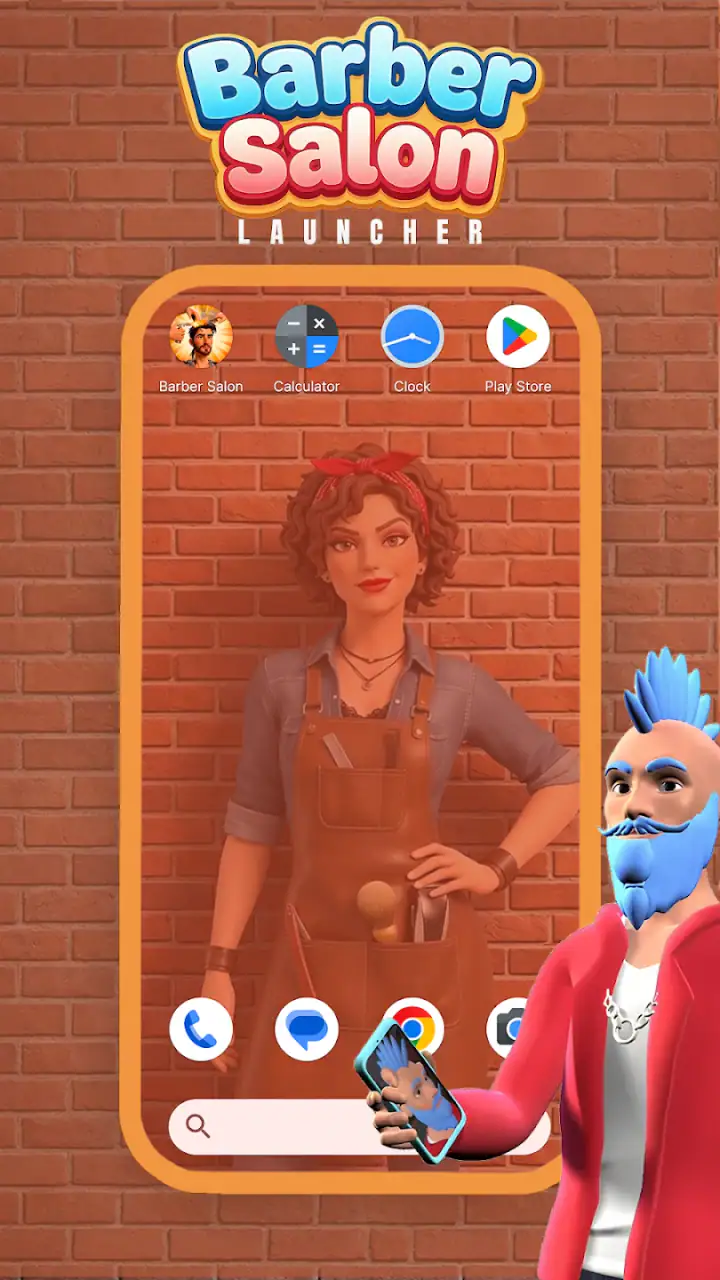
This is one of the app’s less obvious strengths: it encourages visual planning without demanding specialist knowledge. You can think in terms of balance, contrast, and personality, but you do not need to know professional barbering terminology. For a child, that keeps the experience accessible. For an adult, it makes the app a pleasant, low-pressure break rather than another task that requires concentration.
Moving through the salon workflow
The central flow is easy to describe: enter the salon, work with the current client, make appearance-related choices, and complete the look. The pleasure comes from the transition between the starting appearance and the finished version. I enjoyed the moments when a few connected decisions made the client feel noticeably different without requiring a complicated process.
My preferred method was to make broad decisions first and refine later. Establish the overall direction before worrying about small details. If you begin with minor changes, it is easy to lose sight of the result you are trying to create. By deciding on the general style first, each later choice has a clearer purpose and the finished client looks more intentional.
That workflow also helps when the app is being used on a phone by someone with limited patience. Short, ordered actions are easier to follow than a screen filled with competing controls. The experience feels most comfortable when you treat each client as a contained project: start, adjust, review, and finish before moving on.
Handoffs between choices and the final presentation
The important handoff is the moment when individual salon decisions become one complete appearance. This is where the app’s personalization angle earns its place. A single choice may seem minor, but several compatible choices can give the client a recognizable character. I found that the result feels better when I think about the client’s identity rather than selecting options only for novelty.
There is another practical handoff as well: the app moves responsibility from the interface to the player. It gives you a setting and a client, but the satisfaction comes from your judgment. That means two people can approach the same basic task differently. One person may favor a neat, coordinated look, while another may prefer something more playful. The app works because it leaves room for that difference.
For parents, this makes the experience relatively easy to understand. You can see what the child is doing and discuss why a particular look works. For friends, it creates a simple shared activity: one person can suggest a direction while the other makes the choices. I would not describe it as a social platform, but it can still support conversation when used side by side.
Getting a useful result instead of chasing random changes
The outcome is most rewarding when the finished client looks deliberately styled. My practical tip is to use a “three-check” review before considering a salon visit complete: does the overall look feel consistent, does it suit the client’s apparent personality, and is there one memorable detail that makes it unique? This gives the session a clear standard without turning it into a strict scoring exercise.
Another helpful habit is to avoid changing everything at once. If the result feels wrong, revise one area and reassess rather than restarting mentally from zero. That makes it easier to understand which decision affected the overall impression. It also turns mistakes into useful feedback, which is valuable in an app built around experimentation.
The finished result is not only about appearance. Completing a client gives the session a sense of closure. That matters because many casual personalization apps can feel like endless browsing. Here, the salon setting gives you a reason to stop and say, “This one is done.” I appreciated that sense of completion, particularly during short breaks when I wanted an activity with a visible endpoint.
What the app does well for everyday use
A realistic use case is a ten-minute wait before an appointment or while traveling. I could open the app, work through a client, and put it aside without needing to remember a complicated story or maintain a long chain of objectives. The free price makes that kind of occasional use easy to justify, especially for families looking for something approachable on a compatible Android device.
The app is also a good fit for players who like personalization more than competition. There is no need to compare yourself with other players to understand the appeal. The reward is the transformation itself and the feeling that your choices produced a distinct result. That makes the experience gentler than competitive games and less demanding than management titles.
Its current version is 1.0.1, and the app supports Android 8.0 or later. In practical terms, that gives it a fairly broad place on compatible Android phones and tablets, though anyone using an older device should check compatibility before planning around it. I would also keep expectations aligned with the app’s early, focused presentation: the value is in the salon activity, not in a large collection of unrelated tools.
Where the workflow breaks down
The same simplicity that makes the app approachable can become repetitive. If you want a large number of systems, long-term strategy, or a strong sense of progression beyond styling clients and developing the salon, you may run out of novelty. I noticed that the experience is strongest when I played in short sessions. Treating it as a long uninterrupted game makes its narrow loop more obvious.
There is also a creative limitation in any app that centers on predefined salon decisions: your final look is shaped by the choices the app makes available. That is different from drawing a character yourself or using a full editor. If you need exact control over shape, color, or fine visual detail, a dedicated avatar creator will probably suit you better. Barber Salon Launcher is more about guided creativity than unrestricted design.
I would also skip it if your main goal is practical haircut advice. The salon theme may suggest real-world styling, but the app is designed as an interactive personalization experience, not as a professional consultation tool. Someone looking for tutorials, product recommendations, or a way to book a barber should use a service built for those needs instead.
How it compares with the usual alternatives
Compared with a standard character creator, this app has a stronger sense of purpose because the salon provides a beginning and an ending. A general avatar editor may offer more control, but it can feel like a checklist of options. This app is easier to pick up when you want the setting and the task to guide your decisions.
Compared with a full salon-management game, it is lighter and less demanding. You are not choosing it for complex finances, staff scheduling, or a detailed business simulation. That is a weakness for strategy fans, but an advantage for anyone who wants the visual payoff without managing an entire virtual company.
Compared with a makeover app aimed at realistic advice, it is more playful and less useful for making real-life decisions. I would choose the alternative when accuracy or practical guidance matters. I would choose this one when the goal is to experiment, relax, and create a client look without pressure.
Who should install it and who should pass
I recommend it to casual players, children who enjoy appearance customization, and adults who like short creative activities. It is especially suitable for someone who wants a free personalization app with a clear theme rather than an open-ended editor. The Everyone rating also makes it easier to consider for shared family use, while the simple salon premise gives newcomers an obvious way into the experience.
I would be more cautious about recommending it to players who need constant challenge. If you prefer competitive rankings, deep progression, realistic simulation, or a large narrative campaign, the focused salon loop may feel too small. The same applies to anyone who dislikes repeating a familiar structure with different clients. In that case, a broader makeover game or a full character-creation tool would provide more variety.
My final take after following the complete salon journey
Barber Salon Launcher succeeds because it turns personalization into a tidy, understandable workflow. You begin with a client, make a series of connected choices, hand those choices into one finished appearance, and leave with a clear result. I found that structure more satisfying than aimless customization, particularly when I approached each visit as a small design task.
It is not a deep simulation, and its narrow focus can lead to repetition for experienced players. Still, that limitation is also part of its charm. The app does not overwhelm you with systems before you can enjoy the central idea. For a free Android app from Gamnest, it offers an accessible way to spend a few minutes creating distinctive salon looks.
My recommendation is simple: choose it for relaxed, guided customization, and skip it if you need a complex salon business or unrestricted character editor. When used in short sessions and with a little thought behind each choice, it delivers exactly the kind of quick creative outcome its salon setting promises.
FAQs for Barber Salon Launcher
What is Barber Salon Launcher and what features does it offer?
Barber Salon Launcher is a customizable app designed to enhance your Android device's interface with a sleek and professional barber-themed aesthetic. It offers features like personalized icon packs, widget support, a dynamic weather forecast, and various transition effects. Ideal for barber enthusiasts, it transforms your device into a stylish digital salon experience.
Is Barber Salon Launcher compatible with all Android devices?
Barber Salon Launcher is compatible with most Android devices running Android version 5.0 (Lollipop) and above. However, performance may vary depending on the device's hardware specifications. It's advisable to check the app's description in the Google Play Store for specific compatibility details before downloading.
Does Barber Salon Launcher consume a lot of battery and memory?
Barber Salon Launcher is designed to be lightweight, ensuring minimal battery and memory consumption. However, using extensive customization options, live wallpapers, and widgets can increase resource usage. Users can optimize performance by adjusting settings and reducing active customizations if they notice significant battery drain.
Are there any in-app purchases or ads in Barber Salon Launcher?
Barber Salon Launcher is free to download but may include in-app purchases for premium features, such as exclusive icon packs and additional customization options. Users might also encounter ads within the app. The premium version typically offers an ad-free experience and access to all features without limitations.
How can I uninstall Barber Salon Launcher if I'm not satisfied?
To uninstall Barber Salon Launcher, go to your device settings, select "Apps," find "Barber Salon Launcher," and tap "Uninstall." Alternatively, you can long-press the app icon on the home screen and drag it to the "Uninstall" option. Make sure to switch back to your default launcher before uninstalling to avoid interface issues.
Pros
- User-friendly interface for easy navigation.
- Wide range of customization options.
- Lightweight
- doesn't slow down device.
- Regular updates with new features.
- Compatible with most Android versions.
Cons
- Limited widget support compared to others.
- Occasional ads can be intrusive.
- Some features require in-app purchases.
- Not available for iOS devices.
- Lacks advanced gesture controls.


